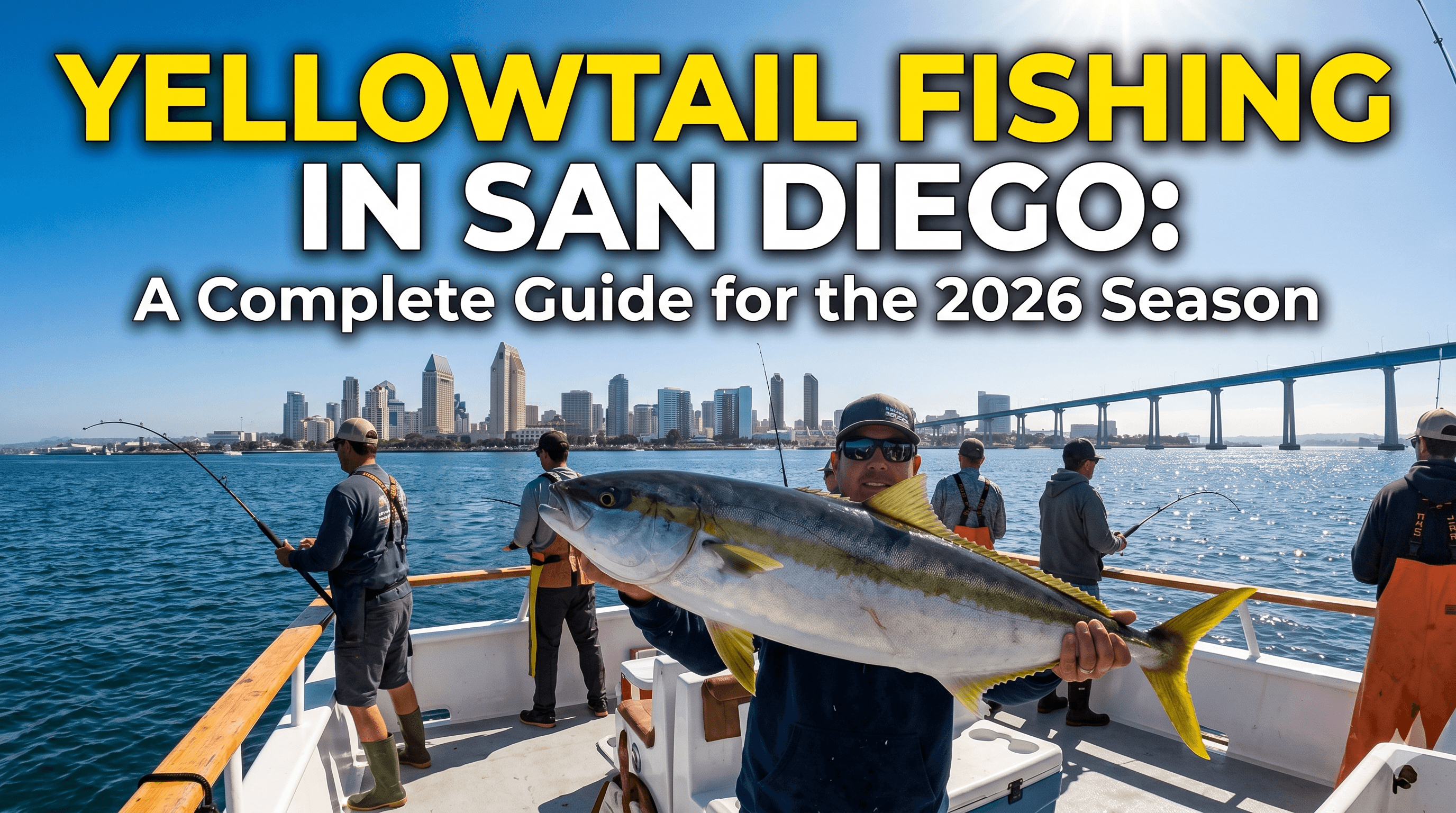
Yellowtail season in San Diego is open right now. The fish showed up on the Coronado Islands in early April and the bite has been steady through the third week, with full-day boats averaging 12 to 20 fish per trip and some running 40+. If you want to catch a yellowtail this year, April through October is your window, and right now is as good a time to book as you'll find.
A quick note from the captain
I've been watching the reports roll in for the last two weeks and it's hard not to get a little giddy. The Grande had 53 yellows for 18 anglers on April 17. The Mission Belle wrapped a Coronado Islands trip with 53 and a halibut. We've had our own days where everyone on the boat put at least one on the deck before lunch, and a few days where we worked hard for four. That's yellowtail fishing. Some days they eat everything you throw, some days you chase them around and come home with one fish and a sunburn. That's the honest pitch. If you want a guarantee, go buy a rotisserie chicken.
If you want to fish yellows this spring out of Dana Landing, our calendar is open and filling fast through May. See May availability.
What is a yellowtail, actually?
Yellowtail (full name: California yellowtail, Seriola lalandi dorsalis) are not tuna. They're a jack, cousins to amberjack and pompano. They hit hard, pull harder, and most of the time they're trying to drag you into the rocks or the kelp to break you off. If you've never hooked one, picture a tuna that went to the gym and developed a grudge.
Local fish run anywhere from 8 to 25 pounds on the kelp beds. The Coronado Islands regulars are usually 15 to 30. Every so often somebody sticks a mossback over 40 and the whole landing talks about it for a week.
When is yellowtail season in San Diego?
Yellowtail are around most of the year, but there's a reason April gets everyone's attention. Here's the honest breakdown:
Spring (April–June): The opener
This is when the fish move in on the Coronado Islands and the local kelp beds. Water temp starts climbing into the low 60s, squid spawns bring the yellows up shallow, and the bite can go from zero to wide-open in a week. Right now (April 21, 2026) we're in it. Boats out of H&M and Point Loma have been reporting 12 to 20 yellows per boat at the Islands on a slower day and 50+ on a good one.
Summer (July–September): The grind
Yellowtail are still around but they scatter. The glamour fish of summer is bluefin, so the yellowtail fleet thins out. That said, if you know the spots, summer yellows are often the biggest fish of the year. Kelp paddy yellows show up offshore and you'll run into them while tuna fishing.
Fall (October–November): The second wind
A late-season bite often kicks in as water temps start to drop. Less pressure, bigger fish, cooler weather. One of my favorite times of year.
Winter (December–March): Slim pickings
They don't disappear completely, but you're working for them. Expect one or two good fish on a full day, or a skunk. If you want to fish in winter, we'll target rockfish, bass, and the occasional surprise yellow.
Short version: If your goal is yellowtail and nothing else, book between April and June, or come back in October.
Where we catch them
Out of Dana Landing, we've got three main zones in play.
The Coronado Islands. The money spot. About 18 miles south of Mission Bay, in Mexican waters, which means you'll need a valid passport or passport card and a Mexican fishing license (we can walk you through the license at Dana Landing before we leave, it's a short process). The Islands hold yellows all season and the current bite is on the north end and around the Middle Grounds.
Point Loma kelp beds. Closer to home, no passport needed, and holds a solid population of 8 to 15 pound yellows through spring and summer. Good half-day option if you don't want to make the run south.
Offshore kelp paddies. Summer game. Yellows hang under floating kelp mats in blue water, usually mixed in with dorado and sometimes tuna. Totally different style of fishing.
How we catch them (the tackle honest talk)
Here's what we run on Butchered Tails for yellowtail. If you've got your own gear, great, bring it. If not, we've got it covered.
- Surface iron rod: 8-foot to 9-foot rod rated 30-50 lb, paired with a Penn Squall II or similar, loaded with 40 lb mono. For throwing jigs like Tady 45s, Salas 7Xs, and the occasional Sumo. This is the most fun way to catch a yellow and the most addictive.
- Flyline setup: 7-foot rod rated 20-40 lb, Shimano Trinidad 14 or comparable, 30 lb fluorocarbon leader, 2/0 J hook. For live sardines when the fish are biting bait.
- Yo-yo jig outfit: Short 6-foot rod rated 40-60 lb, high-speed reel, 50 lb mono or 65 lb braid, with a 6 or 7 ounce yo-yo iron. For when the yellows are sitting deep. This is what H&M is telling anglers to bring right now.
- Backup bait rod: Lighter setup for rockfish, bass, and bonito, because you will catch those too.
Bait is almost always live sardines, sometimes mackerel if we can make them. On the Islands in April, we're fishing a mix of flylined sardines and dropper loop rigs with sardines on them near the bottom structure.
What to expect on a yellowtail trip out of Dana Landing
On a full-day Coronado Islands trip, here's the shape of the day:
- 5:00 AM: Meet at Dana Landing. Grab coffee, get your passport and Mexican license squared away.
- 5:30 AM: Leave the dock, stop for live bait at the receiver.
- 7:00 AM: Lines in the water at the Islands.
- 7:00 AM–2:00 PM: Fish. Move spots as needed. Eat the sandwich you brought. Try not to step on anyone's line.
- 2:00–3:30 PM: Run back, clean fish, back at the dock.
Bring a hat, sunscreen, layers (it's cold leaving, warm by noon), snacks, water, and a cooler with ice if you want to take fish home. No passport, no trip to the Islands, no exceptions.
Frequently asked questions
How big do yellowtail get in San Diego? Local fish average 10 to 20 pounds. Coronado Islands fish average 15 to 30. Anything over 40 is a trophy ("mossback") and worth a photo.
Can you eat yellowtail? Yes, and they're excellent. Firm white meat that takes well to the grill, smoker, or raw as sashimi. If you've had hamachi at a sushi restaurant, that's farmed Japanese yellowtail, a close cousin. Our local fish is leaner and cleaner.
Do I need a Mexican fishing license for the Coronado Islands? Yes. It's about $25 for the day and we'll help you get one at Dana Landing before departure. You also need a valid passport or passport card.
What's the difference between yellowtail and yellowfin tuna? Completely different fish. Yellowtail is a jack, yellowfin is a tuna. Yellowtail stays closer to shore and structure. Yellowfin is offshore and pelagic. People confuse them constantly. Yellowtail is also sometimes called "hamachi" or "amberjack" on menus, which doesn't help.
Is April too early for yellowtail? No. Based on what's happening right now, April is on. The bite can go sideways with a big weather swing, but as of late April 2026, the fish are here.
Book a yellowtail trip
We run 4-pack private charters out of Dana Landing for yellowtail from April through October. Half-day trips hit the local kelp beds. Full-day trips run to the Coronado Islands. Everything's included except your food, your passport, and your Mexican fishing license (we'll help with that last one).
If you want to get in on the current bite, don't wait on it. May fills up fast in a good yellowtail year, and this is shaping up to be a good one.
