San Diego lobster season runs from 6 p.m. on Friday, October 2, 2026, through the end of Wednesday, March 17, 2027, according to CDFW’s 2026–2027 season announcement. These are the recreational season dates for California spiny lobster. Opening and closing times are Pacific time.
There’s plenty to look forward to on an evening lobster trip: heading out with your favorite people, learning something new, and waiting to see what comes up in the next net.
Before that first pull, though, there are a few practical things to sort out. When can you go? What paperwork do you need? And how do you know whether a lobster is legal to keep?
We’ll start with the dates, then walk through the essentials.
When does lobster season end in San Diego?
For the California lobster season 2026–2027, the final recreational fishing day is Wednesday, March 17, 2027. The season closes at 11:59:59 p.m. that evening, not at the end of March.
That means a January, February, or early-March 2027 outing falls within the same season that began in October 2026. CDFW sets the statewide recreational season, while individual trips remain subject to availability, conditions, and any applicable closures.
One detail worth separating: 6 p.m. is the opening-night start time, not a universal departure time for every lobster trip. Use the meeting and departure instructions provided for your particular booking.
What you’re catching: California spiny lobster
The lobster we target here is California spiny lobster, Panulirus interruptus. Unlike the large-clawed lobster many people picture, this species has long antennae and a spiny shell rather than prominent front claws.
California spiny lobsters forage at night, which helps explain the appeal of an evening outing. Their nighttime activity is part of the experience, but it is not a promise that every net will produce a catch.
For a first trip, we suggest making the goal a little broader than dinner: learn how the gear works, get comfortable measuring a lobster, and enjoy being out on the water with your group.
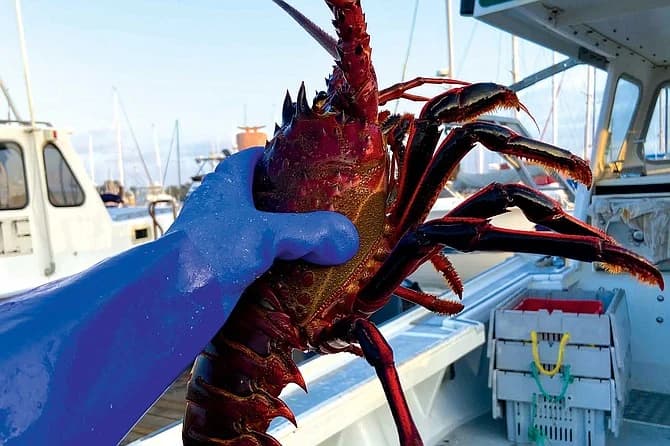
California spiny lobster. Photo courtesy of Nicole Glawson.
How recreational lobster hoop netting works
You don’t have to dive to participate in lobster season. Recreational California spiny lobster may be taken by hand or with a legal hoop net. Commercial-style lobster traps and hook-and-line fishing are not permitted methods of recreational lobster take.
On a hoop-netting trip, the activity centers around baiting, setting, and retrieving nets, then checking the catch. Our crew provides hands-on guidance through those steps.
The basic rhythm is straightforward:
-
Set the net. A baited hoop net is lowered to the bottom.
-
Bring it back up. The net is retrieved and its contents inspected. Hoop nets must be checked at intervals no longer than two hours.
-
Measure and sort. Any lobster caught needs to be measured, with undersized lobster returned immediately.
For recreational hoop netting from a vessel in San Diego waters, the limits are five hoop nets per person and no more than ten per vessel. The vessel limit does not increase just because more guests are aboard. Additional equipment and identification requirements apply, so anyone organizing their own outing should review CDFW’s complete gear rules.
What licenses and report cards do you need?
A fishing license and a lobster report card are different documents. Having one does not automatically cover the other. For a typical San Diego lobster charter, here is the starting point:
| Document | Who needs it? |
|---|---|
| California sport fishing license | Participating guests age 16 and older generally need a valid license. Children under 16 are exempt from the fishing-license requirement. |
| Spiny Lobster Report Card | Everyone fishing for or assisting with lobster needs their own card, including children and people helping deploy or retrieve nets. |
| Ocean Enhancement Validation | Generally required with an annual license for ocean fishing in San Diego. One-day and two-day sport fishing licenses are exempt from this validation requirement. |
CDFW provides the licensing requirements and explains that merely observing, without helping in the fishing process, does not require a lobster report card.
A qualifying public pier has a fishing-license exemption, but that exemption does not apply to a charter boat. It also does not eliminate the lobster report-card requirement for people fishing from the pier.
We recommend arranging your documents before trip day. Check that your license covers the date you’ll be fishing, and use CDFW’s licensing service or an authorized license agent for current options and fees.
Bring the report card, not just the purchase confirmation
CDFW requires a physical Spiny Lobster Report Card while fishing for or taking lobster. Pack it somewhere protected, and bring a pen.
Before putting a hoop net into the water, record the required date, location, and gear information. When you finish at a location or finish fishing for the day, record the number of lobsters kept. Follow the instructions on your card rather than saving all the paperwork for the ride home.
For the 2026–2027 season, report-card information is due by April 30, 2027, including when you caught no lobster or never went fishing. We suggest adding that deadline to your calendar when you buy the card.
San Diego lobster size and catch limits
Before keeping a lobster, check both its size and your individual limit.
| Rule | What to remember |
|---|---|
| Minimum size | The carapace, or body shell, must measure at least 3¼ inches using the required measurement. |
| Daily bag limit | Seven lobsters per person. |
| Standard possession limit | Seven per person, including lobster already retained at home, whether fresh or frozen. |
| Undersized lobster | Measure immediately upon retrieving the net and return undersized lobster to the water immediately. |
These are CDFW’s standard recreational limits. Special multi-day permit provisions are separate from an ordinary evening outing.
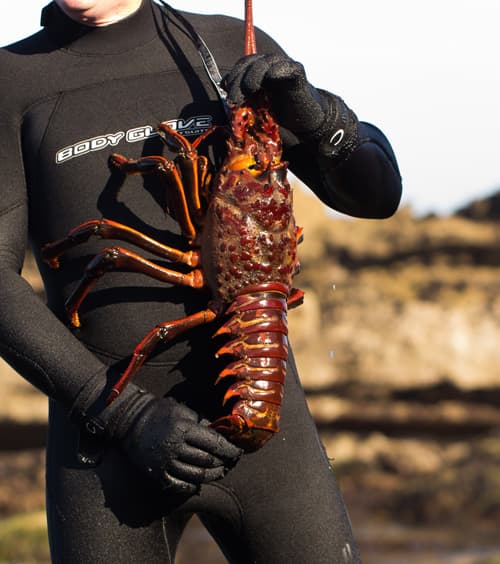
A California spiny lobster held by a diver. Legal size is based on the body shell, not the lobster’s overall length.
Measure the body shell, not the tail
The legal measurement runs along the middle of the lobster’s back, from the rear edge of the eye socket to the rear edge of the carapace. It is not the lobster’s total length, and it does not include the tail or antennae.
Anyone taking lobster must carry a suitable measuring device. We recommend having the crew demonstrate gauge placement before you start judging which lobsters can be kept.
Lobsters must also remain whole and measurable until being prepared for immediate consumption. Don’t remove the tails aboard the boat simply to save cooler space.
Check the location, not just the season
An open lobster season does not mean every stretch of coastline is open to lobster fishing.
San Diego has marine protected areas with specific boundaries and restrictions. For example, lobster take is prohibited in both South La Jolla’s marine protected areas and in Matlahuayl State Marine Reserve. A location that looks promising is not necessarily a legal place to fish.
For a self-organized outing, use CDFW’s Ocean Sport Fishing Interactive Map to check the actual location and its rules. We would not use someone else’s buoy, an old social post, or a crowded stretch of water as confirmation that fishing is allowed.
Also check CDFW’s current health advisories and fishery closures before departure. A seasonal calendar and a current closure notice answer different questions, and both matter when planning a trip.
Planning an evening lobster trip in San Diego
Once the dates and documents are handled, the rest of your preparation can stay fairly simple.
Choose the experience that fits your group
We suggest asking a few practical questions before booking: Is the boat private or shared? How long will you be out? What equipment is provided? How much hands-on participation should you expect?
Let the operator know when someone in your group is new to boating, has a mobility concern, or needs clarification about the physical activity involved. It is better to ask before booking than discover a mismatch at the dock.
You don’t need to impress anyone with what you already know. Arriving ready to listen, ask questions, and follow the crew’s instructions is a useful starting point.
Pack for the evening you’re actually taking
Our packing recommendation is practical: warm layers, non-slip shoes, food, drinking water, and a cooler for transporting any legal catch. Bring your required documents and photo identification as well.
We’d keep everything in one manageable bag and protect your paperwork from spray. Leave unnecessary valuables behind and check with the crew before bringing bulky equipment.
A little preparation should make the trip easier, not turn into a second project.
Confirm the meeting details
Check your booking confirmation for the meeting location, arrival instructions, and departure time. We recommend leaving some flexibility around the trip instead of scheduling another reservation immediately after the expected return.
For a first visit to the launch area, save the directions to Dana Landing before leaving home. Make sure everyone in your group is using the same meeting instructions.
Keep expectations realistic
The legal limit is a maximum, not a promised take-home amount. Our lobster trips target wild animals, and catches are never guaranteed.
We encourage guests to come for the whole outing: the time with their group, the hands-on learning, and the chance to experience the coast after dark. Legal lobster to bring home is something to look forward to, not something to build the entire evening around.
Explore Butchered Tails’ seasonal lobster charter
Our seasonal lobster charter in San Diego is a private, six-hour evening trip for up to four guests, departing from Dana Landing. We provide hoop nets, bait, measuring gauges, and crew guidance. The crew confirms your exact departure time, with a return by midnight. Guests arrange their own required licenses and report cards before departure.
Bring the people you’d like to spend an evening with, get your paperwork sorted, and leave room to learn something new.
Explore Butchered Tails’ seasonal lobster charter
This guide summarizes key recreational rules, not every regulation. Before fishing, check CDFW’s current regulations, location restrictions, and health advisories.